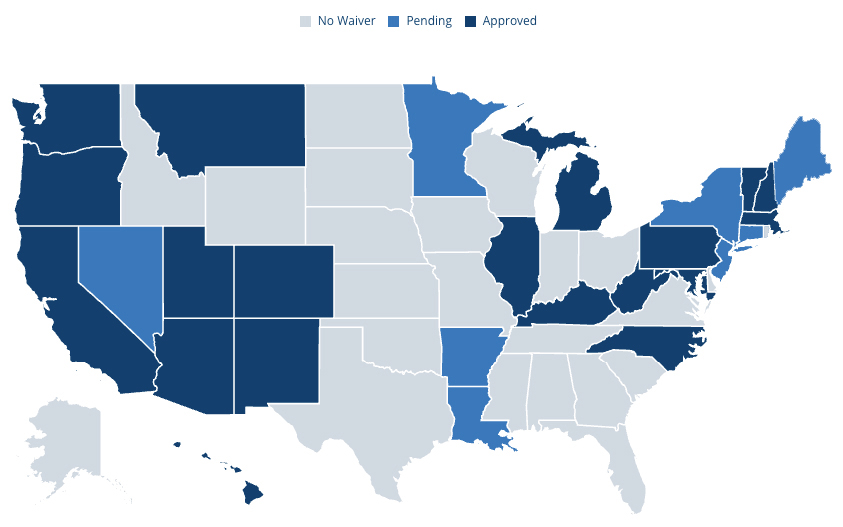
States and the federal government are advancing policies that build access and continuity of services, starting prior to release. A major vehicle for these policies are Medicaid section 1115 demonstration waivers, or “Medicaid reentry waivers.” These waivers allow Medicaid to cover a targeted set of services for individuals starting in the period before they are released from incarceration. The services under these waivers have the potential to improve a range of health and public safety outcomes, including reducing mortality, rates of reincarceration, and unnecessary emergency room visits and hospitalizations. These changes also hold promise to reduce costs for prisons and jails. Waivers are state-initiated, meaning that individual states develop waiver proposals, which the federal government must approve for the proposal to take effect.
There are currently 19 states with approved waivers and 8 plus Washington DC who have proposed waivers for federal consideration. Click on a state on the map below to learn about its reentry waiver.
For the first time, states and the federal government are advancing policies that build access and continuity of services, starting prior to release. A major vehicle for these policies are Medicaid section 1115 demonstration waivers, or “Medicaid reentry waivers.” These waivers allow Medicaid to cover a targeted set of services for individuals starting in the period before they are released from incarceration. The services under these waivers have the potential to improve a range of health and public safety outcomes, including reducing mortality, rates of reincarceration, and unnecessary emergency room visits and hospitalizations. These changes also hold promise to reduce costs for prisons and jails. Waivers are state-initiated, meaning that individual states develop waiver proposals, which the federal government must approve for the proposal to take effect. There are currently 19 states with approved waivers and 8 plus Washington DC who have proposed waivers for federal consideration.
Each state also has a federally approved state plan that governs its Medicaid and CHIP programs, describes how the state will meet federal requirements and which optional policies it is implementing, describes how the programs will be administered, and enables the state to obtain federal Medicaid or CHIP matching payments for the services it provides. When states change their Medicaid programs, they submit a State Plan Amendment (SPA) for CMS review and approval. Some states have submitted SPAs to meet requirements set forth by Section 5121 of the Consolidated Appropriations Act of 2023, which mandates the coverage of targeted case management 30 days before and after release and necessary screening, diagnostic, and referral services 30 days before release or shortly after release for Medicaid and CHIP-eligible youth under age 21 and former foster care youth under age 26 post-adjudication. Additionally, Screening and diagnostic services must meet Early and Periodic Screening, Diagnostic, and Treatment benefit requirements at a minimum. Section 5122 gives states the option to offer comprehensive Medicaid-covered services to youth pending disposition of charges. There are currently 24 5121 specific SPAs and 1 5122 specific SPA that have been approved (as of December 15, 2025).
Click on a state on the map below to find out about its reentry waiver and/or related SPA.
- No Waiver
- Pending
- Approved
Source: Health and Reentry Project (HARP) tracking and analysis of state and CMS actions related to 1115 reentry waivers (download image).